The Hydra Hunt
The Reincarnated Demon King's Host Just Wants to Live in Peace, But the Hero Won't Leave Him AloneThe Hydra Hunt is the Hero’s party’s northern mission to deal with a hydra spotted near Leafel. Although Luc later reports that the creature was defeated easily, its disorientation and apparent search for something suggest that it was not acting independently. The episode therefore links an apparently manageable monster encounter to Tyraz’s continuing efforts to create attacks and regain power, while its departure from Leafel forces Luc and Theo to confront the incompatibility between emerging domestic intimacy and the Hero’s inherited duty.
Causes and Background
The immediate cause of the hunt is a report delivered to the Hero’s party through Micah. A high-ranking monster, specifically a hydra, has been seen heading north, and the party is asked to intervene because it is the highest-ranked adventuring group in the area. The assignment arrives just as Theo has planned to show Luc around Leafel, take him to Fox Tales, and introduce him to Nib. That interrupted plan matters because Luc has been gradually wearing down Theo’s resistance; the mission arrives at the moment when private familiarity might have become a settled routine.
The timing also exposes the structural force governing Luc’s life. Theo recognizes before Luc speaks that Luc cannot remain in Leafel forever. Luc is not merely a powerful adventurer choosing whether to accept a job. He is the Hero, and the party’s status makes dangerous requests part of his ordinary existence. The hydra’s movement northward thus activates the larger system of heroic obligation that repeatedly removes Luc from the possibility of an uncomplicated personal life.
Course of the Mission
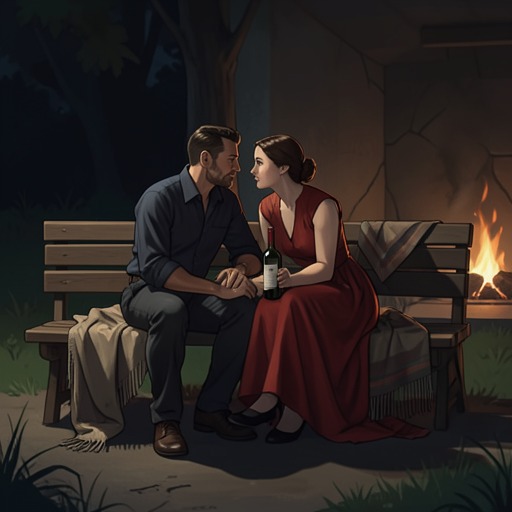
Micah is sent to notify the rest of the party, while Luc remains with Theo long enough to acknowledge their imminent separation. His dark hair is still disordered from sleep and his expression is sorrowful, details that place the public mission against the intimacy of the morning. Theo tells him that he knew this would happen and that Luc cannot stay indefinitely. Luc answers by catching Theo’s hand and promising, “I’ll be back. I promise.” The promise gives the departure an emotional stake beyond the practical completion of the quest.
The party then comes to collect Luc after the meal. Theo escorts him to the front door and sees the other members offer their farewells. Luc’s blue eyes linger on Theo sorrowfully before he leaves along the road toward the dangers awaiting him. The scene ends without a displayed battle, concentrating instead on the departure that the hydra mission causes. In narrative terms, the unseen combat is less important than the visible cost of accepting it: Luc must leave the person and place toward which he has begun to turn.
When Luc returns, he tells Theo that the hydra was dealt with easily and that the local adventurer party probably could have managed it. The creature was disoriented and kept becoming distracted, as though it were searching for something. This report revises the meaning of the assignment. The hydra was dangerous enough to justify intervention, but its conduct was abnormal enough to imply direction, manipulation, or a purpose that neither Luc nor Theo can identify from the encounter alone.
Demonic Implications
Theo immediately wonders whether a demon is behind the hydra’s behavior, and Mal stirs with sudden interest at the suggestion. Luc considers the demonic explanation the most likely one. He connects the hydra to long-standing rumors that Tyraz, the second of the Demon King, is responsible for demon and demon-creature attacks and is attempting to gather enough power to continue the war.
This interpretation expands the hunt from a local act of monster control into a fragment of the continuing conflict between the Hero’s forces and demonkind. The hydra’s distraction becomes a clue that the creature may have been displaced or used as part of a larger design. The party can defeat the immediate threat, but easy victory does not equal resolution; the unexplained behavior leaves the strategic danger intact and points toward an enemy operating through repeated attacks rather than a single open confrontation.
The conversation also raises the rumor that Malthios has reincarnated himself. Luc reports that Eliza believes such a return would already be known, because the host would have to be Theo’s age or older and Malthios would therefore have seized power again by then. The statement is based on an assumption about the Demon King’s return and the age of the host, an assumption that carries dramatic irony because Theo is in fact connected to Malthios. Within the scene, however, the hunt is treated as evidence for Tyraz’s activity rather than proof that Malthios has returned.
Separation and Consequences
The party’s departure turns Luc’s promise into an object of uncertainty. After closing the door, Theo presses his forehead against the cool, smooth wood and convinces himself that he will never cross paths with Luc or his friends again. He reasons that Luc’s quest will carry him far from Leafel and that, during his travels, the Hero will meet many more beautiful people with whom he might form bonds of fate and find a perfect happily ever after. The hydra mission therefore produces an emotional value shift: the possibility of a relationship gives way, at least in Theo’s fearful interpretation, to anticipated abandonment.
Theo’s conclusion contrasts with Luc’s certainty. Luc says he will return; Theo imagines the road taking him permanently away. The difference is not simply romantic insecurity. It reflects the unequal pressures surrounding them. Luc has a party, a mission, and a role that demands movement, while Theo’s life is rooted in Leafel and shaped by his work as a healer. The hunt makes their incompatible temporal rhythms visible: one life proceeds through quests and departures, the other through continuity, waiting, and the preservation of a home.
The promise nevertheless becomes part of the relationship’s foundation. Luc’s later return confirms that the separation is temporary, while the memory of his departure gives their attachment a recurring pattern of absence and reunion. The event’s lasting consequence is therefore double. On the public level, the Hero’s party removes a hydra and uncovers signs of Tyraz’s wider campaign. On the private level, Luc’s departure tests whether a connection formed in Leafel can survive the obligations that define him.
Narrative Significance
The Hydra Hunt adapts the quest pattern while quietly resisting its conventional reward. The Hero receives no glorious on-page triumph in the available account; the hydra is handled easily, and the decisive dramatic movement lies in the road out of Leafel. The expected heroic progression from call to victory is displaced by the emotional aftermath, where the cost of answering the call is measured in separation rather than in bodily defeat.
The episode also foreshadows the conflict between heroic bloodline duty and chosen intimacy. Luc’s earlier relationships ended or became impossible because the Hero’s travels prevented lasting attachment. Later, Hero Eliza explicitly pressures him to preserve the Hero’s bloodline and produce the next Hero, while Luc rejects that imposed future in favor of a quiet life with Theo. The hydra mission is an early instance of the same system at work: a public emergency interrupts private happiness, and Luc must decide whether returning to the person he loves can be treated as a duty of equal seriousness.
In that sense, the hunt is both an external adventure and a test of narrative direction. The party travels north to answer the world’s demand for a Hero, but Luc’s promise points toward a different kind of return, one centered not on conquest or inherited succession but on Theo and Leafel. The hydra is defeated; the larger war remains. More importantly, Luc’s departure establishes that the relationship’s future will depend on whether he can come back from the heroic road without allowing that road to dictate the whole shape of his life.